Arizona was not alone in criminalizing abortion in the 19th Century, though the legislative history described in the press was perhaps unique. Other recent articles describe the influence of organized medicine in the efforts to criminalize abortion.
Below is an excerpt from my book, Beyond Choice, which gives the background to the campaign of Anthony Comstock, Arizona and the other states to criminalize abortion. Note the quote from a physician promise ent in this effort about the racial effects of a world with no restrictions on birth control or abortion. The white male saw their hegemony threatened. How better to remedy this than to restrict white women’s access to preventative measures.
From beyond Choice, Chapter 1
The Demise of Reproductive Freedom in the 19th Century
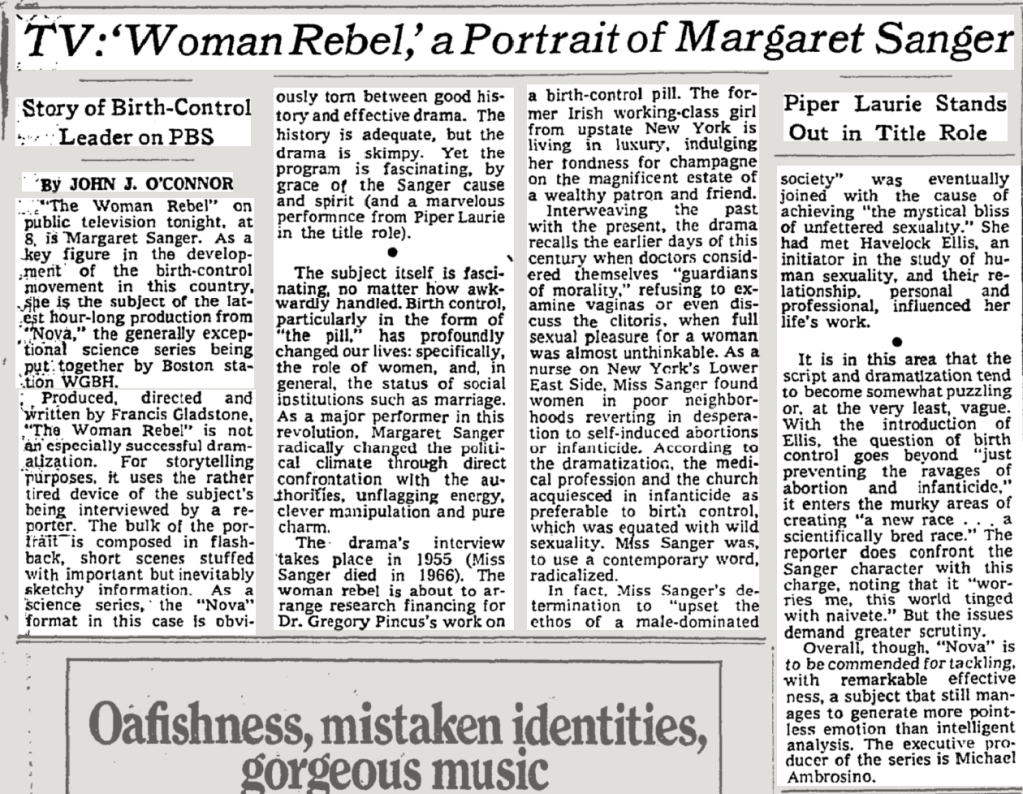
The birth control movement which my grandmother, Margaret Sanger, started in the early 20th century was a reaction to the 19th century pro-life movement that succeeded in reversing American and British law, which had permitted birth control and abortion, and in criminalizing them both almost entirely. The campaign to restrict reproductive freedom was not solely based on a respect for unborn life at its earliest stages. Rather it was a campaign founded upon the institutional imperatives of organized medicine, the Protestant reaction to Irish Catholic immigration, and the feminist and fundamentalist drive for social purity in sexual matters.
During the 19th century physicians began to unravel the mysteries of reproductive biology and fetal development. The ovum was discovered, as was the process of fertilization. The 19th century was also the time when university-trained physicians sought to control the practice of medicine. In our overly regulated society it is hard to imagine a time when there were few if any restrictions on who could “practice medicine”. In fact, until university-trained physicians appeared on the scene, midwives and other non-university trained doctors called “irregulars”, as well as outright quacks, were the main practitioners of medicine. They not only diagnosed medical conditions but also distributed all kinds of homemade drugs to their patients. Medical potions and patent medicines were concocted and sold with virtually no regulation or oversight. While official records are skimpy, it seems that the first legislative restrictions on the practice of abortion were enacted as a result of efforts by “regular” physicians to protect the safety of women to whom dangerous abortifacient potions were being given by “irregulars”. There is some evidence that America’s first law, in Connecticut in 1821, which banned the giving of a “potion” to cause an abortion in a woman “quick” with child, came out of an effort by physicians to ban all home-made herbal remedies, whether for abortion or not, as simply being too dangerous. When New York enacted its ban on abortion in 1828, it banned abortion before or after quickening unless two physicians determined the abortion was necessary to save the woman’s life (a vastly broader category of cases than in current times).
University-trained physicians also had a financial motive to put their competition, the irregulars, midwives and quacks, out of business. These irregulars made a healthy part of their income by providing contraception and abortion, as well as childbirth services. As a result, regular physicians began to pressure legislatures to put the control of pregnancy prevention and termination in the hands of physicians only. Thus the early statutes, like in New York, permitted abortions only when two physicians agreed and other later abortion statutes allowed physicians to exercise their medical judgment and perform abortions when they thought it necessary.
The formation of the American Medical Association in 1841 by the physician-regulars accelerated the legislative process of putting medicine in general and reproduction in particular into physician hands. The AMA made it one of its first items of business as the trade association for physicians to put the irregulars out of business. Over the course of the next century as their medical expertise grew physicians took control of childbirth and largely succeeded in removing it from the home under the supervision of a midwife to the hospital under the supervision of a physician. With contraception and abortion physicians took a more drastic route—they sought to criminalize them both either entirely or if not done under a physician’s supervision. They didn’t bother to hide their financial motive. James C. Mohr, in his book “Abortion in America”, relates that the Southern Michigan Medical Society in 1875 was reminded by one of its members: “Regular physicians are still losing patients, even long time patients, to competitors willing ‘to prevent an increase in their (patient’s) families’ by performing abortions.”
On abortion this strategy dovetailed with new biological discoveries that pregnancy was a continuum from conception to birth and that quickening had no medical significance. Physicians began to agree with some religious leaders that pre-born life deserved their total respect and protection and that abortion should not be permitted except for therapeutic reasons. This belief was an historical part of their professional obligations, since the traditional Hippocratic Oath written by the Greek physician Hippocrates in about 400 BCE said: “I will not give to a woman a pessary to produce abortion”.
The AMA alone was not able to bring about the criminalization of abortion. At the beginning of their campaign in the 1840’s and 1850’s they allied themselves with the Know-Nothings, a fledging political party of nativists, whose main platform consisted of opposing Irish-Catholic immigration into America, which had begun to increase exponentially. The Know-Nothings wanted to preserve their control over the then mostly Anglo-Saxon, Protestant society. Their platform was a mixture of nativism, temperance and religious bigotry. The platform called for limits on immigration, for political offices being restricted to native-born Americans, and for a 21-year waiting period before an immigrant could vote. They sought to limit the sale of liquor, to require that all public-school teachers be Protestants, and to have the Protestant version of the Bible read daily to all students in public school. The Know-Nothings feared that they, the native-born Protestants, would soon be outnumbered and outvoted by the new Catholic immigrants. Their goal was to preserve the primacy of the Anglo-Saxon, Protestant religion, culture and political power.
It did not escape Protestant notice that immigrant Catholic women had large numbers of children, while native Protestant women were having fewer. Since few new birth control methods had been introduced at this time— although there was the beginnings of condom and diaphragm manufacturing— the Know-Nothings suspected that Protestant women were using abortion as their method of birth control. Physicians studying who were having abortions confirmed this suspicion. Hence, the Know-Nothing men readily joined the AMA crusade to criminalize abortion. As contraceptive options increased in the course of the 19th century, those who favored the white Protestant hegemony also supported the criminalization of contraception.
Racial fears were thus a major part of the impetus to control women’s fertility. As one prominent physician said in 1874: “The annual destruction of fetuses has become so truly appalling among native American (Protestant) women that the Puritanic blood of ’76 will be but sparingly represented in the approaching centenary.”
Even though men took the lead in advancing the medical, political and racial arguments for the criminalization of birth control and abortion, some women were also in favor of this legislation, as they were in favor of other “social purity” campaigns after the Civil War that sought to enact laws to restrict various immoral pursuits such as gambling, drinking and prostitution. In these campaigns the political odd bedfellows, the Know-Nothings and the regular physicians, were joined by some women’s rights activists. As Ellen Chesler, my grandmother’s biographer, described it: the native white Americans seeking to preserve their hegemony “were joined by religious fundamentalists, physicians looking to secure their status, and self-proclaimed feminists who believed they were promoting their own autonomy by regulating sexual behavior and by attacking pornography, alcohol and vice.” Into the vice category fell any expression of human sexuality other than between married couples for purposes of reproduction.
Nineteenth century feminists, an admittedly small and relatively powerless group, supported what they called “voluntary motherhood”. Voluntary motherhood was to be achieved not by promoting birth control and abortion but rather by controlling male sexuality. Some feminists believed that birth control and abortion did more than enabling voluntary motherhood; they enabled their husbands to consort more freely with “other women”. Feminists believed that their own voluntary motherhood could be achieved by periodic abstinence and self-control, their own and their husband’s.
So Anthony Comstock, an official of the YWCA who headed the New York Society for the Suppression of Vice, found ready allies in some feminist circles for his social purity campaign to prevent the dissemination through the U.S. mails of obscene materials, which he defined to include any information on human sexuality, reproduction, birth control and abortion. Every publication or article “designed, adapted, or intended for preventing conception or producing abortion, or for any indecent or immoral purpose” was banned. After Congress enacted the Comstock Laws in 1873 that banned sexuality, birth control and abortion information from the mails as contraband, individual states followed suit and criminalized the dissemination of contraceptive and abortion information and devices within their borders, though with some variations that permitted greater or lesser discretion to physicians. The result was that by the last quarter of the 19thcentury birth control and abortion had essentially been criminalized at both the state and federal levels.
The result was not that birth control and abortion were thereby eliminated from American society. Instead they largely went underground. Some forms of birth control methods remained available but were sold under euphemistic titles. Abortion potions were sold as a tonic for “female problems”, diaphragms were “womb supports”, and condoms were called “rubber goods”. Andrea Tone in “Devices and Desires: A History of Contraceptives in America” states: “…legal leniency, entrepreneurial savvy, and cross class consumer support enabled the black market in birth control to thrive.” It is difficult to estimate how widely contraception and abortion were used, whether the poor were able to afford them or how safe and effective they were. We can surmise that almost everyone in American society had access to either birth control or abortion because the birth rate continued its century long decline even after both were criminalized.
Reproductive freedom was a threat to the power structure in 19th century America. It threatened physicians, who wanted to monopolize the practice of medicine; it threatened Anglo-Saxon Protestants who wanted to maintain their control over American society, culture and politics; and it threatened those men and women who viewed any expression of sexuality outside the home as a threat to marriage and decency. The campaign to criminalize birth control and abortion found many allies, and it succeeded. Anthony Comstock became one of the most powerful men in America.







 Alexander Sanger